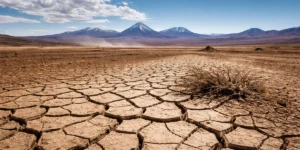
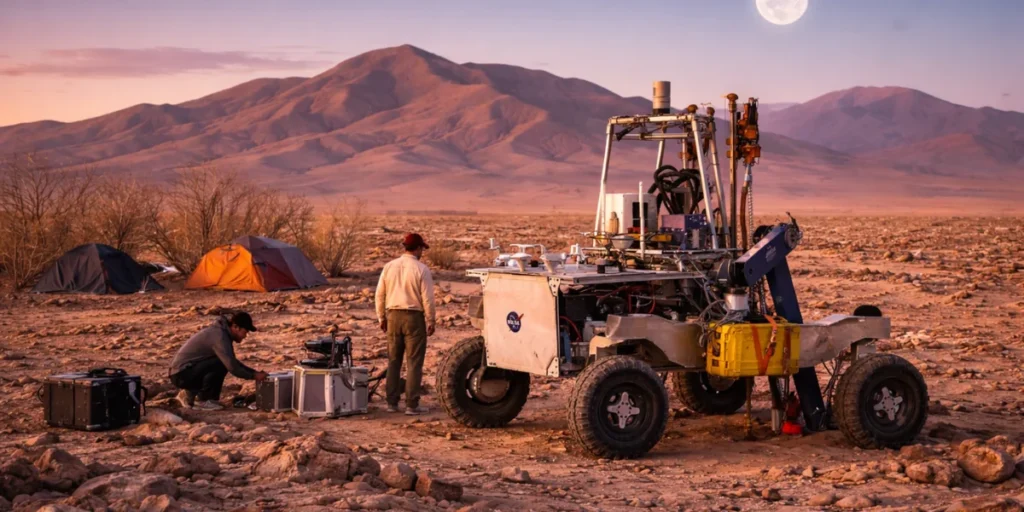
You are in the middle of the Atacama Desert, surrounded by stones, silence, and a landscape that seems not to belong to Earth… and suddenly you understand why. NASA in Atacama It doesn't sound as strange as it seems. The soil here is so dry, so ancient, and so extreme that many scientists consider it one of the most Mars-like places on our planet. It's no coincidence that engineers and research teams come here to test space technology.
While most travelers look at the desert thinking of volcanoes, salt flats, or starry skies, in some areas of the Atacama Desert, tests are being conducted that relate to the future of space exploration. Rovers, sensors, and experiments that could one day operate on Mars are first confronted by this brutal environment. That's why, when we talk about NASA in Atacama, It is said that this desert impresses not only with its beauty, but also with its scientific value.
Why the Atacama Desert interests NASA
When you walk through Atacama you quickly understand why. POT It focuses on this spot. It's not just because it's dry, it's because it's... extremely dry, old and stable. Here there are areas where it hasn't rained for centuries, the soils are laden with salts, and solar radiation is intense. All of this creates an extreme environment, perfect for testing technology that will one day have to function in even harsher conditions, like those on Mars.
For NASA, the Atacama Desert is a natural laboratory. There's no need to artificially recreate certain scenarios because they already exist here. Sensors, life-detection instruments, navigation systems, and scientific protocols are tested in a place where the margin of error is minimal. If something works in the Atacama, it has a much greater chance of working beyond Earth. That's why this desert isn't studied out of mere curiosity, but out of scientific necessity.
Furthermore, the Atacama Desert allows for something crucial: separating the biological from the geological. In an environment where there is almost no life, any organic sign stands out. This is fundamental for learning to distinguish between natural processes and possible traces of life, one of the great questions of space exploration. In that sense, the Atacama Desert not only resembles Mars, it helps us learn how to search for Mars.
Which areas of Atacama are used for scientific testing
Scientific testing is not concentrated in a single point of the desert, but in different areas that offer specific conditions. Some areas are chosen for their extreme aridity, Some are due to the chemical composition of the soil, and others to their complete isolation. In many of these areas, there are no nearby human settlements, roads, or external interference, allowing work to proceed in highly controlled environments.
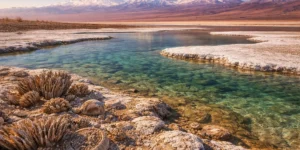
There are areas where the soil is so saturated with salts that it is almost sterile, ideal for testing instruments that search for microorganisms or minute chemical signals. In other areas, scientists focus on ancient lakebeds, salt flats, or volcanic terrain because they offer clues about how water behaves, or how it may have behaved in the past. Each type of landscape serves a different purpose.
What's interesting is that many of these tests are carried out quietly, without much fanfare. There aren't always signs or visible structures. The desert still seems empty to the traveler, but in reality, it has been explored and studied for years by international scientific teams. Atacama has this dual nature: it appears untouched, yet it is one of the most analyzed territories on the planet.
Atacama as the place most like Mars on Earth
Saying that the Atacama Desert is the place most like Mars on Earth isn't just a marketing slogan. It's a comparison based on real data. Both share salt-rich soils, low levels of organic matter, high radiation, and extreme aridity. There are areas of the desert where microbial life is so scarce that it closely resembles what one might expect—or not expect—to find on Mars.
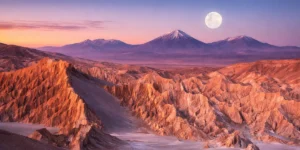
Visually, the similarity is also striking. Reddish, brown, and ochre hues, open landscapes devoid of vegetation, eroded rock formations, and a constant sense of isolation. In certain areas, the silence and complete absence of landmarks make the environment feel alien, almost extraterrestrial. It's no wonder that scientists and travelers alike say that walking through the Atacama is the closest we'll ever get to walking on another planet.
But what's most important isn't how it looks, but how it works. The Atacama Desert allows us to study how geological information is preserved in a dry environment for millions of years, something crucial for interpreting data arriving from Mars. That's why this desert not only inspires comparisons, but also helps prepare for the future of space exploration. And in the meantime, it remains one of the most breathtaking places a traveler can visit on Earth.
What kind of space technology is being tested in the desert?
In Atacama, they don't test just anything. Technologies designed to survive where the margin for error is minimal arrive here. Rover-type vehicles, for example, are tested on hard, saline, and broken terrain, very similar to what might be found on Mars. It's not just about them moving forward, but about them doing so autonomously, avoiding obstacles, and following precise routes without constant assistance from a base.
Sensors and scientific equipment designed to detect minute traces of water or organic compounds are also being tested. In a desert where there is almost no life, any signal stands out, allowing instruments to be calibrated with a precision that would be impossible in biologically "noisier" environments. Additionally, drilling systems, soil analysis equipment, and devices that must withstand intense radiation, sudden temperature changes, and fine dust are being tested.
What do scientists look for when they come to Atacama?
Scientists don't come to Atacama looking for easy answers. They come to make mistakes here so they don't make them up there. One of the main goals is to understand how to distinguish signs of real life from purely geological processes. In such an extreme place, it's possible to study what kind of traces life leaves when it exists and what an almost completely barren environment looks like.
They also seek to understand how time preserves information in dry environments. Atacama allows them to study how minerals, sediments, and structures are maintained for millions of years without being altered by water. This is key to interpreting what is observed on other planets, where water may have existed in the past but is no longer present.
Furthermore, Atacama is a human testing ground. Here, protocols, work methods, timelines, and decision-making processes are tested in isolated locations, much like on a space mission, where every action counts and improvisation has clear limits.
How these tests help explore other planets
Everything tested in the Atacama Desert has a clear objective: to reduce uncertainty. If a technology fails in this desert, it's very likely to fail on Mars. That's why every mistake here is a valuable learning experience. Adjusting sensors, changing materials, improving algorithms, or modifying procedures is all done before the technology leaves Earth.
Atacama also helps in interpreting data. Images, samples, and measurements arriving from other planets cannot be understood on their own. They need comparison. Studying soils, salts, and structures here allows us to create models that are then applied to Martian data. It's like having a geological dictionary built on Earth to correctly interpret another world.
In that sense, the desert is not only useful for testing machines, it's also useful for training the scientific eye. It helps to ask the right questions and avoid drawing hasty conclusions when data is limited, something common in space exploration.
Why Atacama is key to the future of space exploration
Atacama is key because it combines factors that rarely coincide in one place: extreme aridity, climatic stability, geological diversity, and vast, largely undisturbed areas. This makes it an ideal environment not only for current testing but also for research looking decades into the future. As space missions become more complex, the need to test under real-world conditions becomes even more critical.
Furthermore, Atacama is not a closed laboratory. It is a living, accessible territory where science coexists with local communities, tourism, and conservation. This necessitates a more responsible and environmentally conscious approach to exploration, something that will also be crucial beyond Earth.
For all these reasons, when discussing the future of space exploration, Atacama appears time and again. Not as a mere backdrop, but as an ally. A place on Earth that, paradoxically, helps humanity prepare to leave it.