When we talk about the oldest mummies in the world, Most people automatically think of Egypt. However, thousands of years before the pyramids were built, a culture that deliberately mummified its dead already existed on the coast and in the desert of northern Chile. In the heart of the Atacama Desert, the Chinchorro mummies shattered all known notions about the relationship between early human societies and death.
These mummies are remarkable not only for their age, but also for the extreme context in which they were created and preserved. The arid climate of the Atacama, combined with surprisingly complex ritual techniques, allowed these bodies to survive millennia almost intact. Understanding why these are the oldest mummies in the world It involves looking at the desert not just as a landscape, but as a natural archive of human history.
Who were the Chinchorro and where did they live?
The Chinchorro were communities of hunters, gatherers, and fishers who inhabited the coast of what is now northern Chile and southern Peru more than seven thousand years ago. They lived in an extreme environment, between the Pacific Ocean and the Atacama Desert, where the availability of resources was limited but constant thanks to the sea. Their diet was based primarily on fish, shellfish, and marine mammals, which allowed them to establish relatively stable settlements without the need for developed agriculture.
Unlike other ancient cultures, the Chinchorro did not build large cities or monuments. Their legacy lies not in architecture, but in the intimate relationship they developed with their dead. They lived in small groups, scattered along the coast and in oases near the desert, in a landscape where the aridity and salinity of the soil dictated the rhythm of daily life. This same harsh and unforgiving environment would ultimately play a key role in the preservation of their human remains.
The most striking aspect of the Chinchorro culture is that mummification was not reserved for elites, leaders, or special individuals. Adults, children, and even newborns underwent complex funerary rituals. This suggests a profoundly egalitarian view of death and a strong symbolic significance associated with the body, memory, and belonging to the group.
Why these are the oldest mummies in the world
The Chinchorro mummies are considered the oldest mummies in the world because archaeological records place them several thousand years before the first known mummifications in Egypt. Some datings reach more than 7,000 years old, completely shattering the traditional idea that mummification was a phenomenon exclusive to large, complex civilizations.
What makes this even more surprising is that this preservation wasn't accidental, caused solely by the weather. In many cases, the bodies were intentionally manipulated, disassembled, and reassembled, demonstrating a highly advanced technical and ritual knowledge for a society considered technologically "simple." This antiquity isn't just chronological; it's also conceptual: the Chinchorro had already developed a symbolic relationship with death when other cultures were only just beginning to organize themselves.
The extremely dry climate of the Atacama Desert helped these mummies survive to the present day, but it doesn't fully explain their existence. Similar practices from such an early period are not found in other deserts around the world. This reinforces the idea that Chinchorro mummification was a unique cultural response, deeply rooted in their worldview, and not simply a result of their environment.
Mummification techniques thousands of years before Egypt
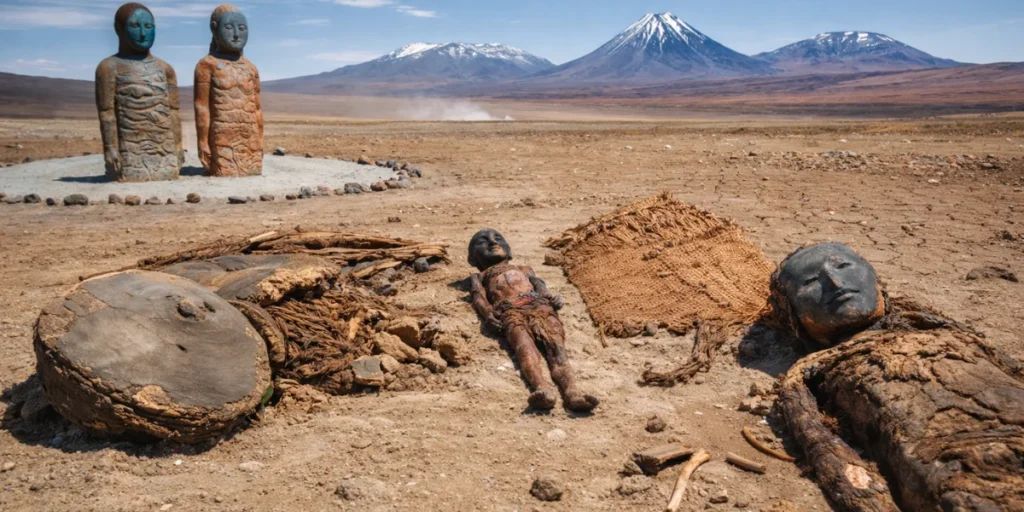
The mummification techniques developed by the Chinchorro people are so complex that they surprise even modern archaeologists. In many cases, the process began with the complete removal of the skin and internal organs. The skeleton was reinforced with sticks, plant fibers, and clay to restore its stability, and then the body was re-covered, reconstructing its original form.
There are different styles of Chinchorro mummification, such as the so-called black mummies and red mummies, distinguished by the materials and pigments used. Some were coated with a mixture of manganese, others with iron oxides, and many included carefully modeled facial masks. These masks did not aim for exact realism, but rather a symbolic representation of the human face, as if the individual were still present within the community.
This entire process required time, knowledge, and a clear intention. It was neither an improvised act nor a simple preservation of the corpse. It was an elaborate ritual that involved "recreating" the dead person, giving them a new form, and keeping them integrated into the world of the living. The fact that these techniques existed thousands of years before the Egyptian ones demonstrates that cultural complexity is not always associated with great empires, and that some of the most profound ideas about life and death arose in places as extreme as the Atacama Desert.
The role of the Atacama Desert in its conservation
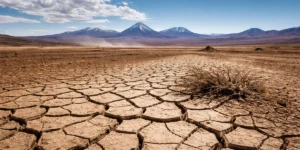
The Atacama Desert was not only the setting where the Chinchorro people lived, but also a key factor in preserving their remains for millennia. The extreme aridity of the environment, with almost no humidity and exceptional rainfall, created ideal conditions to slow organic decomposition. In many areas, the saline soil and the stable climate acted as a natural preservative, helping the human remains withstand the passage of time in a way that is almost unique in the world.
Unlike tropical or temperate climates, where humidity accelerates decomposition, the Atacama Desert maintains a constant dryness that limits the action of bacteria and microorganisms. This allowed the Chinchorro mummies, even those not buried at great depths, to preserve tissues, skin, and internal structures for thousands of years. The desert functioned as a natural archive, where time seems to move more slowly.
This exceptional preservation doesn't mean the climate alone was responsible. Without human intervention, many bodies would have decomposed anyway. But the combination of advanced mummification techniques and an extremely dry environment made Atacama one of the few places on the planet capable of preserving such ancient human remains in such detail.
What the Chinchorro mummies reveal about prehistoric life
The Chinchorro mummies offer a direct window into the daily lives of prehistoric communities about which we would otherwise know very little. Through their bodies, archaeologists have been able to study diseases, diet, injuries, and even patterns of physical activity. Everything points to societies that lived closely linked to the sea, with a diet rich in marine protein and a constant interaction with a harsh environment.
But beyond the biological data, these mummies reveal a profound social dimension. The fact that all individuals, regardless of age or status, were mummified suggests a cohesive community where death did not sever the bond with the group. Mummification appears to have been a way of keeping the deceased present, symbolically integrating them into daily life.
They also reveal a surprising technical and symbolic capacity. These communities, without writing or large-scale constructions, developed complex rituals that involved planning, anatomical knowledge, and a strong spiritual dimension. The Chinchorro mummies force us to reconsider the idea that cultural complexity only arises in large agricultural civilizations.
Differences between the Chinchorro and Egyptian mummies
Comparing the Chinchorro mummies with the Egyptian ones helps to understand why the former are so exceptional. While in ancient Egypt mummification was primarily reserved for elites and linked to a hierarchical religious structure, among the Chinchorro it was a collective and profoundly egalitarian practice. Regardless of social rank, everyone deserved the same care after death.
The techniques also differed radically. In Egypt, the process aimed to preserve the body as it was, removing organs and carefully dehydrating it. In the case of the Chinchorro, the body was disassembled and reconstructed, reinforced with natural materials and given a new form. It was not just about preservation, but about symbolically recreating the individual.
Furthermore, chronology makes a key difference. The Chinchorro mummies predate the Egyptian ones by thousands of years. This demonstrates that mummification was not an invention exclusive to one great civilization, but rather an independent cultural response, arising in a completely different context, both geographically and socially.
Atacama as one of the great archaeological sites of the planet
The Atacama Desert is not only home to the oldest mummies in the world, but also boasts an archaeological wealth that places it among the most important territories for the study of human history. Throughout its oases, coastlines, and inland valleys, remains have been found spanning thousands of years of continuous occupation, from prehistoric groups to later Andean cultures.
The exceptional preservation of the environment allows for the study not only of isolated objects, but of entire contexts. Tools, textiles, human remains, and structures are preserved in a state rarely found elsewhere in the world. This makes Atacama a natural laboratory for archaeology, where each discovery provides precise and tangible information about the past.
Beyond its scientific value, Atacama represents a cultural heritage of immense importance. Understanding its history is not just about looking to the past, but about understanding how humankind has been able to adapt, create meaning, and leave its mark even in the most extreme environments on the planet. Therefore, Atacama is not just a tourist destination or a breathtaking landscape; it is one of the great living archives of human history.