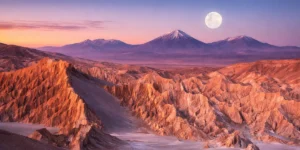
It's hard to imagine when you're surrounded by salt flats, volcanoes, and miles of dry land, but the The Atacama Desert was once the seabed Millions of years ago. Where you now walk on salt crusts and eroded rocks, there was once water, marine life, and sediments that slowly accumulated at the bottom of an ancient ocean. The desert holds this history in plain sight, though many travelers pass by without noticing.
If you look closely, the Atacama is full of clues: marine fossils, layers of salt, minerals, and formations that don't fit the classic idea of a desert. That's one of the great curiosities of this place. The Atacama wasn't always dry, high, or hostile. Its current landscape is the result of millions of years of geological changes that transformed an ancient sea into one of the most extreme deserts on the planet.
When the Atacama Desert was under the sea
What we call the Atacama Desert today wasn't "born a desert." The landscape you see around San Pedro, the high plateau, and the salt flats is the end result of a very long history in which water played a central role for entire periods. Millions of years ago, much of this area was influenced by marine or coastal environments and by basins where sediments from the sea and ancient rivers accumulated. It wasn't "a beach" as we imagine it today, but a constantly changing system: the sea advanced and retreated, bays, coastal plains, deltas, brackish lagoons, and shallow seabeds formed, where marine life left behind remains that were buried.
Then came the great turning point: the Earth here began to rise. The Andes Mountains, which today define the entire horizon, weren't always this high. Over time, tectonic activity raised the continent, deforming the terrain, creating inland basins, and isolating areas that were once connected to the ocean. It's as if the "floor" of that ancient seabed was slowly lifted and moved away from the sea, while the climate became increasingly arid. This uplift didn't happen suddenly; it occurred over millions of years, which is why the desert is like an open book with overlapping pages: ancient layers below, younger layers above.
Meanwhile, the Pacific coast and cold currents helped prevent moisture from easily penetrating, and the mountain range ended up acting as a barrier to the rains arriving from the east. Over time, water ceased to dominate the landscape, and the wind became the primary sculptor. This is why Atacama is so geologically "clean": with little rainfall, the layers erode slowly, preserving many ancient features. It is one of the few places where you can look at the ground and feel as if you are witnessing processes from another era, not something "covered up" by vegetation or modern soils.
Visible evidence that Atacama was once a seabed
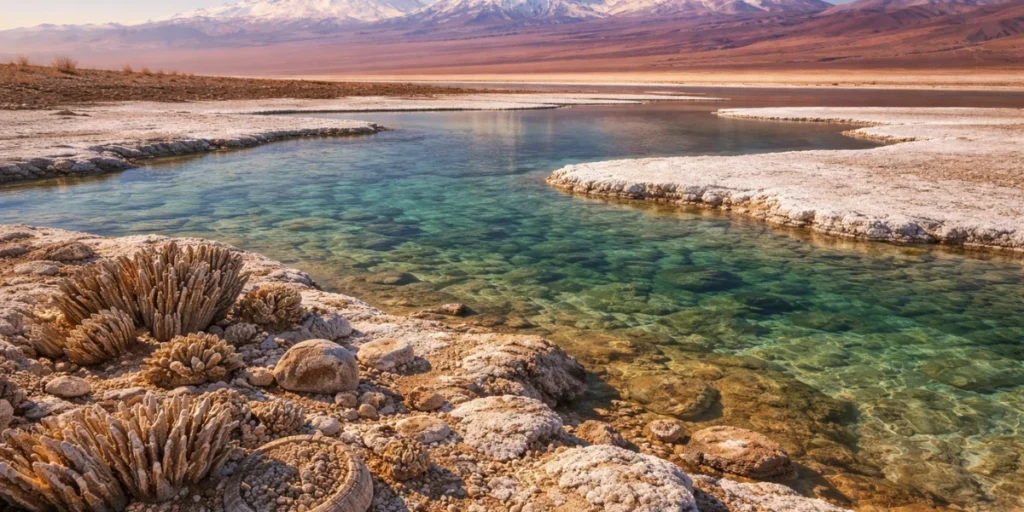
The first clue is usually salt, and I'm not just talking about "salt flats." I'm talking about white crusts, surfaces that look like ice, salt edges that trace lines like ancient shorelines. These salts don't appear by magic: they are the result of water that was there, concentrated, and evaporated, leaving minerals behind. In many areas, you literally see a transition of colors in the terrain, as if the ground were telling you where there was water and where it dried up. It's a type of landscape that is more reminiscent of an ancient salt lakebed than a typical "sand desert.".
Another very clear sign is certain layered rock formations, like stacked pages. There are areas where you can distinguish horizontal or slightly inclined, repeated, thin strata with textures that don't fit with a purely volcanic origin. These layers are usually sediments: materials that were deposited in water or coastal environments and that compacted over time. In humid deserts or those with vegetation, these layers are hidden. Here, since there is almost no organic soil above them, they are easily visible: lines, steps, natural terraces.
There are also landforms that resemble "ancient edges": terraces, raised plains, surfaces at different levels. Often, people look at them and only see "plateaus" or "strange flat areas," but these geometries can be related to former water levels or basins that filled in and were later exposed when the land rose or the water receded. If someone tells you about it on the road, suddenly everything makes sense: "This was the bottom, this was the edge, there was a basin here, the water evaporated here.".
And then there's the detail I love because it's so Atacama: in some places, the ground has remnants that look "marine" even though you're far from the ocean. Encrusted shells, calcareous fragments, stones with organic shapes, textures reminiscent of coral or marine colonies. You don't need to be a geologist to suspect that something more than wind and sun happened there.
Marine fossils found in the middle of the desert
One of the most disconcerting things about exploring the Atacama Desert with someone who knows how to read the terrain is discovering that, amidst a dry and silent landscape, remnants appear that don't fit the idea of a desert. Shells embedded in the rock, calcareous fragments with organic shapes, and sedimentary layers reminiscent of seabeds are clear signs that there was once marine life here. This isn't an isolated or anecdotal finding: in various areas of northern Chile, marine fossils have been found hundreds and even thousands of meters above sea level.
These fossils belong primarily to mollusks and organisms with hard parts, which are the most resistant to the passage of time. Interestingly, they are not "hidden" underground as in other parts of the world. In Atacama, the lack of rain and vegetation means that many of these remains are exposed or semi-exposed, directly integrated into the landscape. You walk on soils that are, in reality, ancient, uplifted, and dried-out seabeds.
Beyond their visual impact, these fossils tell a very specific story: they didn't arrive here by chance. They are direct proof that the territory was under marine influence for long periods and that subsequent geological processes were responsible for uplifting them and moving them away from the ocean. In Atacama, the past isn't buried; it's in plain sight for those who take the time to observe.
The role of tectonic plates and the Andes
To understand how the Atacama Desert went from being a seabed to one of the driest places on the planet, we have to look towards the Andes Mountains. The uplift of this mountain range is one of the fundamental keys to the entire transformation of the landscape. For millions of years, the collision between tectonic plates slowly raised the continent, pushing ancient marine sediments upwards and deforming the terrain.
This uplift not only changed the land's elevation but also completely altered the climate. As the Andes grew, they began to act as a massive barrier, blocking moisture from the east. At the same time, the Pacific coast and cold currents reduced the influx of moisture from the west. The result was a land increasingly isolated from water, where rainfall became exceptional.
This process explains why today you can find marine fossils at high altitudes and, at the same time, an extreme desert surrounding them. The soil didn't simply "dry up" overnight; it was uplifted, isolated, and exposed to an increasingly arid climate. In this sense, the Atacama Desert is a perfect example of how tectonics and climate work together to radically transform a territory.
How the sea gave rise to salt flats and minerals
The sea not only left fossils in the Atacama Desert, but also an enormous chemical legacy. Many of the salts and minerals that define the desert landscape today originated in ancient bodies of water that evaporated over time. When the sea or marine lagoons became isolated and began to dry up, the water evaporated, but the dissolved minerals remained, accumulating layer upon layer.
This is how many of the salt flats that amaze travelers today were born. These white, hard, and cracked surfaces are nothing more than the residue of millions of years of evaporation. Each crust of salt tells a story of water that was once there and slowly disappeared. That's why the Atacama salt flats are not simply "dry lakes," but geological archives of a marine and lacustrine past.
Besides common salt, these processes concentrated other minerals that are now famous in the region, such as lithium and various sulfates. It all stems from the same logic: water arrives, stagnates, evaporates, and leaves behind what it carried. The Atacama Desert, seen in this light, is not just a dry place; it is the end result of a receding ocean and a constantly shifting Earth.
Why did Atacama go from ocean to extreme desert?
The transformation of the Atacama Desert was neither abrupt nor simple. There wasn't a moment when the sea "disappeared" and the next day the desert appeared. What happened here was a slow, cumulative transformation, deeply linked to the Earth's major geological movements. For millions of years, this area went through periods where water was commonplace, whether in the form of the sea, coastal lagoons, or inland basins. But as the continent began to rise, that equilibrium was disrupted.
The progressive lifting of the Andes Mountains It was a decisive factor. As it gained altitude, it not only pushed ancient seabeds upwards, but also completely altered air circulation and humidity. The mountain range became a natural barrier blocking rainfall from the east, while cold currents from the Pacific limit evaporation and cloud formation. The result is a territory trapped between two climatic barriers, where water simply cannot reach.
With less rainfall, bodies of water began to disappear. Lakes evaporated, inland seas became isolated, leaving behind salts and minerals, and the wind became the primary force shaping the landscape. Unlike other places in the world, where new rain cycles "reboot" the terrain, in Atacama the dryness persisted and intensified. This continuity is key: the desert not only formed, it consolidated over millions of years without major interruptions.
That's why the Atacama is so extreme. It's not just a dry desert; it's an ancient desert. Its aridity is neither recent nor accidental, but the result of geological and climatic processes that aligned in a very unusual way. The ocean receded, the land rose, the rains stopped, and time did the rest.
Atacama as a natural archive of Earth's history
Few places on Earth allow us to "read" the history of the planet as clearly as the Atacama Desert. In many environments, vegetation, water, and human activity erase or obscure the traces of the past. Here, the opposite is true. The lack of rain, minimal erosion, and stable climate have transformed the desert into a kind of open-air natural archive, where layers of time remain visible.
In Atacama, you can find, all in one place, signs of ancient oceans, traces of volcanic activity, sediments carried by water, salt flats formed by evaporation, and landscapes sculpted almost exclusively by the wind. Each layer, each color of the soil, and each texture tells a different story about a specific stage in the planet's history. You don't need to be a scientist to perceive this; simply observe how the landscape seems "ordered," as if nothing has been disturbed for a very long time.
This exceptional preservation is what makes Atacama so valuable to science, but also so fascinating to the curious traveler. Here you don't just see a beautiful landscape; you see processes that are normally hidden beneath kilometers of soil or jungle. You walk across a territory that has changed from sea to mountain, from lake to salt flat, from a humid environment to one of the driest in the world, and it preserves all those stages without concealing them.
So we can confirm it: Atacama is not just a tourist destination or a stunning desert. It's a geological summary of the Earth in its almost purest form. A place where time doesn't feel rushed or superficial, but profound. And perhaps that's why, when someone understands what they're seeing, the desert stops seeming empty and begins to feel full of history.