There are places on the planet where gazing at the night sky becomes an almost surreal experience. Where the stars aren't isolated points, but rivers of light traversing the firmament, and the surrounding silence makes everything feel larger, more ancient. In one of those places, the sky isn't just observed: it's contemplated for minutes, even hours, without the need for telescopes or prior knowledge.
In the heart of the Atacama Desert, the night sky reaches a level of clarity that defies description. The combination of altitude, extreme climate, and near-total absence of light pollution has made it a global benchmark for astronomers, photographers, and travelers seeking to view the Milky Way like nowhere else on Earth. This isn't an opinion: it's a fact backed by science… and by anyone who has ever looked up here on a clear night.
Why does the Atacama Desert have the best sky in the world?
When people say that Atacama has "the best sky in the world," they're not just talking about the fact that you can see a lot of stars. They're talking about a combination of factors that rarely coincide in one place, and when they do, they do so with an intensity that's difficult to replicate anywhere else on the planet.
Here the sky isn't a black background with dots; it's a living, deep, textured layer, dotted with patches and clouds of light. The biggest difference isn't the number of stars, but the contrast. In Atacama, the black of the sky is truly black, and that detail changes everything, because when the background darkens so much, any faint light source becomes evident: dim stars, interstellar dust, star clusters, areas where the Milky Way looks like smoke.
To understand this, imagine the sky as a photograph. In a humid or hazy place, it's as if you put a translucent filter in front of the lens: the light scatters, the brightness is "washed out," and even if there are stars, you lose definition. In Atacama, that filter is almost nonexistent. The atmosphere is "cleaner" in the practical sense: less water vapor, fewer particles, less interference.
This is noticeable even without any astronomical knowledge, because the initial impression isn't "how beautiful," but rather "how can it look like that?" And this effect intensifies the further you get from San Pedro and any other light pollution, because light pollution, which in other parts of the world is so commonplace as to seem inevitable, can be reduced almost to zero here with a simple trip outside the town.
Furthermore, the Atacama is not just a "desert": it's a high-altitude desert, with cold nights, winds that cleanse the air, and a climate that, although it may sound contradictory, is stable enough to observe. In many destinations famous for their skies, the problem is variability: clouds that roll in without warning, humidity that rises and falls, and abrupt changes.
In northern Chile, especially in the high plateau and around San Pedro, the sky often has the consistency that allows for planning, repetition, and refinement. That's why not only tourists come here, but also massive scientific projects are established here: because to observe the universe you need the same things you need to experience it with the naked eye with excitement—a dark, clear, dry, and predictable sky.
And there's another key point, more human than technical. The landscape is captivating. You're not looking up from a city filled with noise, buildings, and streetlights. You're standing in an open environment, with a wide horizon, silhouetted mountains, and a silence that forces you to slow down. That changes your perception.
In Atacama, the sky is unrivaled. There are no screens, no reflections, no "backlighting." Just you, the cold, and the firmament. It's a complete sensory experience, and that's why, even though the reason lies in the physics of the atmosphere, what you remember is how it made you feel.
An extreme climate that plays in favor of the stars
Atacama is extreme in a way that can be uncomfortable for travelers during the day and captivating at night. The dryness cracks lips, the temperature swings force you to dress in layers, and the sun beats down even when the air feels cool.
But all that might seem "harsh" is precisely what makes the sky so transparent at nightfall. The key here is that extreme weather is often accompanied by an atmosphere with little water vapor. And water vapor is one of astronomy's greatest enemies because it absorbs and scatters light, creates halos, increases the "milky sky" effect, and reduces sharpness.
In humid areas, even with a clear sky, the humidity hangs like an invisible film. You can see it with the naked eye because the stars twinkle more, the moon creates an exaggerated glow, and the horizon appears hazy. In Atacama, many nights have this almost razor-sharp clarity. The cold air, especially in winter or during the transitional seasons, helps the sky feel cleaner. It's not magic: the cold reduces the air's capacity to hold water, and in a place where it already rains very little, the result is an exceptionally dry atmosphere.
This dryness not only affects observation in general, but also something very specific: how you perceive the Milky Way. The Milky Way isn't a "white line." It's a band with varying densities, with dark clouds of dust, with brighter nuclei, with regions that look like brushstrokes. To see these nuances, you need a sky that doesn't obscure them with haze. Atacama allows you to see them because the air isn't filled with things that block the passage of that faint light.
The wind is another ally. In many deserts, dust ruins transparency. In the Atacama, however, depending on the area and the time of year, the wind acts like a sweep, stabilizing and "cleaning" layers of air. The atmosphere isn't a single layer; it's a set of layers with different temperatures and movements. When there's too much turbulence, the stars twinkle and the image becomes distorted. In certain high-altitude areas of northern Chile, this turbulence can be less pronounced during extended periods of the year, and that's a boon for observation, even for the naked eye, because the sky appears more "steady," more profound.
Then there's the issue of cloud cover, which seems obvious but isn't. Some destinations have weeks of incredible skies followed by a whole month of bad weather. In Atacama, the general trend is consistently clear nights, although there are more challenging seasons, such as the Andean winter at certain times of the year, which can bring cloud cover and high-altitude storms.
The important thing is that outside of those episodes, the probability of usable skies is very high, and that translates into something practical: you can travel with the realistic expectation that you will see stars, not with your fingers crossed in hope.
This extreme climate also limits vegetation and, by extension, restricts large settlements and extensive urban areas in many places. This matters much more than it seems, because it's not just about "not having a city nearby," it's also about not having a network of towns illuminating the horizon as there is in other regions.
In Atacama, natural isolation helps keep the night sky dark. It's not just meteorology: it's geography and population density. A less habitable climate makes for a more habitable sky to look up at.
Altitude, dryness and zero light pollution
Altitude is a concept sometimes explained with numbers, but it's best understood through feeling. The higher the altitude, the less atmosphere there is above you. Less air to pass through means less light scattering. If you're in a low valley, you look at the sky through a thicker "column" of air. As you climb, that column shortens. That doesn't automatically turn any mountain into an astronomical paradise, but when combined with dryness and atmospheric stability, the effect is breathtaking.
In the San Pedro de Atacama area, you're already at a high altitude by world standards. And if you venture towards the viewpoints, plains, and routes of the Altiplano, the experience is even better. This difference is especially noticeable in the horizon and the quality of the sky visible to the naked eye. There are nights when the horizon seems almost drawn, without that gray layer that in other places always appears close to the ground. And this expands the useful field of vision: you not only see what's above, but you also see constellations that are lost in hazy places when they're low in the sky.
The dryness, which we already mentioned as part of the climate, becomes the perfect partner of the altitude here. Because if you climb to a high but humid place, you're exposed to the humidity. If you climb to a high and dry place, you're closer to a purer sky. Atacama has an advantage because of this combination. It's as if the environment was designed for it. astronomical observation, although it is actually the result of geological and climatic processes of thousands and millions of years.
And then there's the factor that most ruins the sky in the rest of the world: light pollution. It's not just about "seeing fewer stars." Artificial light changes the color of the sky, turning it gray, yellowish, or orange, and obliterates the finest details. Even a medium-sized city can ruin the sky for miles around because the light rises, bounces off particles in the air, and spreads out. That's why you can be "out in the countryside" and still see a glow on the horizon that steals the darkness.
Atacama has one advantage: vast expanses with very low population density and an astronomical culture that, in many places, protects the night sky. This translates into something simple for the traveler: just venture a little way to find true darkness.
The kind of darkness that makes you realize your eyes are adjusting, and you start seeing more and more as the minutes pass. In destinations with light pollution, this adaptation process is of little use because the ambient light never diminishes. In Atacama, it does diminish, and that's why the experience improves over time: after five minutes you see one thing, after fifteen you see another, after thirty you wonder how many stars there really are.
The absence of artificial light also helps photography, but even if you don't take a single picture, your perception improves. Because artificial light doesn't just blur stars, it also blurs contrast. And contrast is what makes the Milky Way appear structured, not a blurry smudge. When the background is truly dark, your eye begins to read the sky as a map with volume.
This point is important for managing expectations. Not all nights are the same. The moon, for example, can be so bright that it seems to "turn off" the stars. On a full moon, even in Atacama, the sky loses its impact in the classic sense of the intense Milky Way.
You still see a beautiful sky, but the Milky Way is lower in the sky. On moonless nights or nights with a very low moon, the difference is otherworldly. That's why the "best sky in the world" also depends on choosing the right time, but the essential point is that, when conditions are just right, the Atacama Desert is so far above the world average that you don't need to be an expert to notice it.
The Milky Way as you've never seen it before
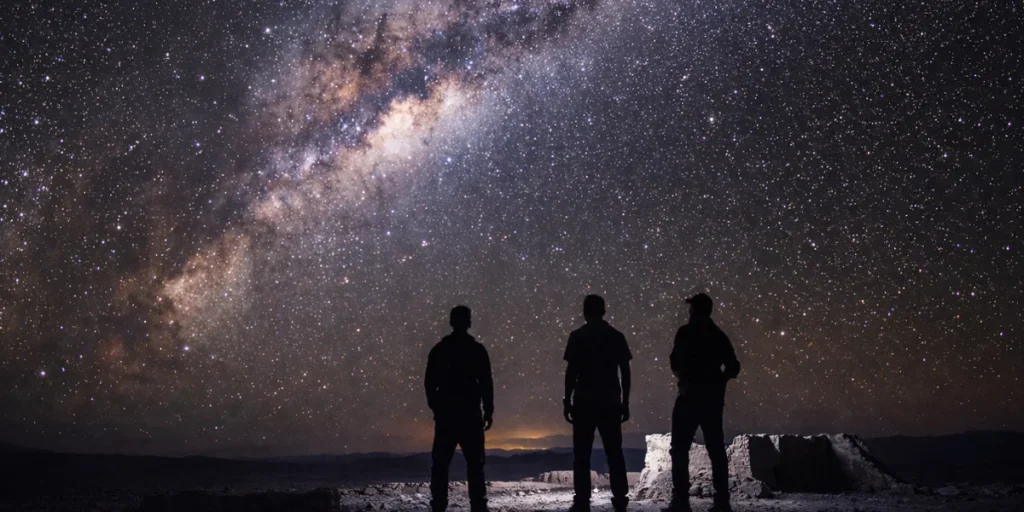
The first time you see the Milky Way for real, it's usually a quiet shock. It's not a fireworks display. It's more of a presence. A vast band that doesn't look like a band at all; it looks like a layered cloud of light.
And what's most surprising about Atacama isn't that you can see it, but that you can see it in detail. You see bright areas and dark areas, as if someone had brushed over it with light paint and then with charcoal. These dark gaps aren't a "lack of stars": they're interstellar dust blocking the light coming from behind, and when you first notice it, the sky ceases to be merely decorative and becomes three-dimensional.
In many places, people believe the Milky Way is something only visible in long-exposure photographs. In Atacama, you understand where those photos come from, because the human eye already grasps the basic idea: texture, density, a path of light. The camera amplifies it, yes, but it doesn't invent it.
That changes the kind of experience. You're not looking for a specific point; you're reading a structure that crosses the sky. And if you take the time, you begin to see how that structure moves. Not because it's moving fast, but because the Earth rotates and the sky "moves forward." After an hour, the position has changed enough for you to notice, and that sense of time and scale is part of the charm.
Where you look also matters. In Atacama, with its wide horizon, you can see the Milky Way from its low peak near the mountains to its peak stretching overhead. There are nights when the galactic core appears with an almost unreal intensity, like a dense, luminous cloud.
At other times of the year, the Milky Way is in a different part of the sky, or its core is less visible while its extended band is more prominent. It's not that the sky "gets worse"; the type of spectacle changes. This is something many travelers don't consider: the Milky Way isn't always in the same position or with the same visible intensity, and the Atacama Desert allows you to observe these cycles.
The clarity of the sky also makes the constellations feel different. In cities, constellations are reduced to their main stars. Here, secondary stars appear, and the pattern becomes more complex. And because there are so many stars to see, at first it's even difficult to find familiar figures, because the sky is "too full.".
It's a curious feeling: you come looking for more stars, and when you find them, you become disoriented because your urban reference point was a simplified sky. That moment is very Atacama-like: you realize that the real sky wasn't the one you had in your head.
For the traveler seeking a complete experience, the Milky Way in Atacama is more than just looking. It's about feeling the landscape transform into a silent stage, how the cold compels you to be fully present, and how time seems to stretch out. You don't need a telescope for a memorable night, but if you combine it with a guided observation, you'll understand more: what you see ceases to be "a cloud" and begins to be "a galaxy," what appears to be a point becomes a planet, and what seems like a smudge becomes a cluster. But even without a guide, the core experience is there, because Atacama offers you the sky in its rawest and purest form.
Astronomical observatories and science in Atacama
The fact that some of the most important observatories on the planet are located in Atacama is neither a coincidence nor a tourism marketing ploy. Top-tier scientific institutions have spent decades studying the climate, atmospheric stability, and sky quality before installing infrastructure here that costs billions. Projects such as SOUL or the observatory of Paranal They are not looking for "pretty" skies, they are looking for extremely precise, constant and reliable skies, and Atacama fulfills all of that better than almost any other place in the world.
These observatories operate in spectral ranges invisible to the human eye, yet their requirements align perfectly with what makes a night sky spectacular for a traveler. They need dryness, stability, few clouds, and minimal light pollution. When a scientist tells you that a sky is exceptional, they're not just being romantic; they're saying it because the data confirms it night after night. This gives Atacama an undeniable authority when discussing the best skies in the world.
For visitors, knowing they are looking at the same sky studied by professional astronomers adds an extra layer to the experience. You're not just stargazing for pleasure; you're standing beneath a gigantic natural laboratory. And although many observatories aren't regularly open to the public, their very existence is clear proof that this sky isn't a tourist gimmick, but a scientific resource of global value.
Astrotourism: looking at the sky as a travel experience
He astrotourism in Atacama It goes far beyond simply "seeing stars." It's about transforming the sky into a complete experience, where the surroundings, the silence, the temperature, and the cultural context are just as important as what you see above. Many people arrive without knowing how to identify constellations and leave with the feeling of having experienced something profoundly different, even emotional. It's not a technical tour; it's a sensory experience.
Unlike other destinations, you don't need enormous telescopes to enjoy the sky here. There's enough to amaze you with the naked eye, and when you add a guided observation, the sky begins to make sense. What was once a smudge becomes a galaxy, what looked like a star turns out to be a planet, and the sky ceases to be merely decorative and becomes a story. This blend of simple explanation and extreme environment is what makes astrotourism in Atacama so successful.
Furthermore, astrotourism integrates seamlessly with the rest of the trip. It doesn't compete with other attractions; it complements them. During the day, you explore arid landscapes, volcanoes, and salt flats, and at night, the sky provides the perfect finale. Many travelers end up remembering a night under the stars more than a specific excursion because the impact is more intimate and less predictable.
Best places to see the stars in Atacama
One of the reasons Atacama stands out from other astronomical destinations is that there isn't a single "magic spot" for stargazing. The sky is so good that the entire surrounding area works in its favor. Just a few minutes from San Pedro de Atacama, You only need to get away from the town lights to find yourself in real darkness, the kind that allows your eyes to adapt quickly and begin to reveal layers of the sky that simply don't appear elsewhere.
Open areas, without nearby hills to block the horizon, often offer a better experience than enclosed spaces. Secondary roads, plains, and areas with sweeping vistas allow you to observe the Milky Way from its low-lying beginning until it crosses the sky completely. Here, the landscape is simple, almost bare, and that helps ensure nothing visually competes with the firmament. You don't need infrastructure or specially prepared viewpoints: the desert itself does that work.
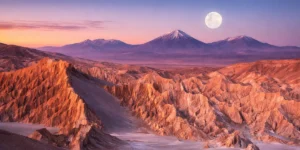
Some places combine dark skies with a particularly powerful visual environment. Valley of the Moon, For example, the sky is complemented by a geography that reinforces the feeling of being off-world. Seeing stars above eroded formations, ridges, and dunes creates a sense of depth that can't be achieved in flat areas. However, it's always important to respect access and opening hours, because not all areas are suitable for unguided nighttime visits.
For those seeking even more extreme skies, the high plateau offers outstanding conditions. Areas near El Tatio High-altitude routes offer even darker and clearer skies, though they require more preparation due to the cold, the altitude, and the distances. In these places, the silence is almost absolute and the sky feels closer, but it also demands respect and planning. The best place isn't always the most remote, but rather the one that allows you to enjoy yourself without stress or rushing.
When is the best time to observe the night sky
In Atacama, you can see stars year-round, but not every night offers the same experience. One of the most important factors is the moon. On nights with a full moon, the sky is so bright that the Milky Way fades into the background, even here. That's why the new moon or very thin crescent moon phases are the most sought-after for observing the sky in all its splendor.
The seasons also play a role. Clear nights predominate for much of the year, but in some months the so-called highland winter can occur, bringing cloud cover and storms at higher altitudes. This doesn't mean the sky will be bad for weeks on end, but it does mean there is greater variability. Outside of these periods, nighttime stability is generally high, allowing for fairly confident planning.
Another detail that many travelers discover along the way is that the Milky Way changes position depending on the time of year. There are months when the galactic core is very visible and others when it appears more spread out but less bright. Neither option is worse, just different. The key is to adjust expectations and understand that the Atacama sky is not a fixed spectacle, but a stage that transforms over time.
Real tips for stargazing in Atacama
One of the most common mistakes is underestimating the nighttime chill. Even if the day has been warm, the temperature drops quickly at night, and being uncomfortable prevents you from enjoying it. A proper coat, hat, and gloves make a huge difference when you're spending time stargazing. Another key point is patience: your eyes need between fifteen and thirty minutes to fully adjust to the darkness, so avoiding screens and bright white lights greatly enhances the experience.
The moon is a crucial factor. It doesn't ruin the night, but it does change the type of sky you'll see. If your goal is to see the Milky Way in all its glory, it's a good idea to research the lunar phases and prioritize nights with little or no moonlight. If there is a moon, the sky is still impressive, but the spotlight shifts to planets, constellations, and the naturally illuminated landscape itself.
It's also important to understand that not all nights are the same. There are just okay nights and then there are memorable nights. The wind, the clarity of the sky, and the time of day all play a role. Sometimes the sky improves as the night progresses, and staying a little longer than planned can make all the difference. In Atacama, the sky rewards those who aren't in a hurry.
Why does someone who comes once want to return at night?
Many travelers come to Atacama drawn by its daytime landscapes and discover the sky almost by chance. And that's where something changes. Seeing the stars under these conditions isn't just another attraction; it's an experience that stays with you in a unique way. It's not remembered as an excursion, but as a personal, silent moment, difficult to replicate anywhere else.
The Atacama sky can't be fully appreciated in a single night. Each visit is different: the position of the Milky Way changes, the visible constellations change, even your perspective shifts. The first time is breathtaking, the second time you understand it better, the third time you savor it more calmly. That's why many people, even those who have already been, seek to repeat the nighttime experience.
In the end, Atacama doesn't just show you stars; it restores a connection with the sky that is often lost in everyday life. And when someone rediscovers that, even if only for a few hours in the middle of the desert, they are usually left with the feeling that one night wasn't enough.