To say that The Atacama Desert is the driest in the world This isn't an exaggerated phrase or a catchy tourist slogan. It's a statement backed by climate records, scientific studies, and measurements that have been repeated for decades. In some areas of this desert, located in northern Chile, there hasn't been any rain for hundreds of years, creating an environment so extreme that scientists even use it to study the limits of life on Earth.
But the aridity of the Atacama Desert cannot be explained by a single cause. It is the result of a unique combination of geographic, climatic, and atmospheric factors that act simultaneously and reinforce each other. Understanding why The Atacama Desert is the driest in the world It involves looking beyond the lack of rain and analyzing ocean currents, mountain barriers, air circulation, and an unusual climate stability on a global scale.
Where is the Atacama Desert and what makes it unique?
The Atacama Desert is located in northern Chile, stretching between the Pacific Ocean and the Andes Mountains. It's a long, narrow strip where, in just a few kilometers, you go from sea level to over four thousand meters above sea level. This location, sandwiched between two natural giants, is one of the keys to understanding why this desert is so different from any other in the world.
What makes Atacama unique is not just that it doesn't rain much, but that It has been extremely dry for millions of years.. It's not a young desert, nor a territory that dried up "recently." Here, the aridity is deep, ancient, and constant. This has allowed the landscape to remain almost intact, without fertile soils, without vegetation covering the rocks, and without processes that erase the traces of the past. That's why Atacama doesn't seem like just any desert: it seems like a place frozen in time.
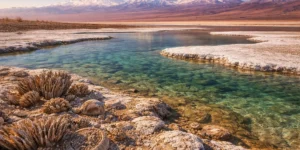
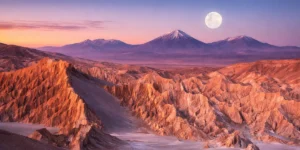
Furthermore, its diversity is astonishing. Within the same desert, you'll find salt flats, volcanoes, endless plains, canyons, oases, and high mountain areas. This variety, combined with the extreme aridity, makes the Atacama a natural laboratory for both science and the curious traveler who wants to understand how the Earth functions under extreme conditions.
The Humboldt Current and its role in extreme drought
One of the main reasons for the Atacama's dryness isn't on land, but in the ocean. The Humboldt Current, which runs along the Pacific coast from south to north, carries cold water from southern latitudes. This cold water cools the air above the ocean and reduces evaporation, meaning less moisture is available to form rain clouds.
When that cold air reaches the northern coast of Chile, it generates coastal fog but not heavy rain. It's a deceptive humidity: the sky may appear overcast, but the water doesn't fall. This lack of evaporation is key, because even though it's next to the ocean, the Atacama Desert doesn't receive significant precipitation from the sea. The water is there, but it doesn't manage to turn into rain.
This phenomenon creates a paradox that baffles many travelers: an extremely dry desert right next to the ocean. In other parts of the world, such proximity usually means humidity and rain. In the Atacama, the opposite is true. The Humboldt Current acts as a climate brake, keeping the atmosphere stable and dry, thus reinforcing the aridity year after year.
The natural barrier of the Andes mountain range
If the ocean fails to bring rain, there's not much luck on the other side either. Andes Mountains It acts like a gigantic wall, blocking moisture from the east. The humid air masses generated in the Amazon and the interior of the continent collide with this mountain range and release their moisture before crossing it. By the time the air manages to reach the Chilean side, it is already dry.
This double barrier is what makes the Atacama so extreme. On one side, the cold ocean limits evaporation and rainfall. On the other, the Andes prevent continental moisture from reaching the desert. The Atacama is trapped in between, with no real sources of water from either front. It's almost perfect climatic isolation.
Furthermore, the mountain range's altitude contributes to climate stability. By blocking frontal systems and constant rainfall, the desert maintains remarkably similar conditions over long periods. This stability is one of the reasons why the Atacama is not only dry, but consistently dry, and why it has become a unique place on the planet for both science and those seeking to understand how an extreme desert forms.
Altitude, atmospheric pressure and lack of rain
In the Atacama Desert, altitude is not a minor detail; it's part of the problem—and the explanation. Many areas of the desert lie between 2,000 and over 4,000 meters above sea level. At that altitude, the air is thinner, atmospheric pressure is lower, and the air's capacity to hold moisture decreases. Simply put: even if water vapor were available, the air has a very hard time transforming it into rain.
This low pressure combines with a very stable atmosphere. There are no large masses of air rising and cooling, which is what normally generates storm clouds. In Atacama, the air tends to remain still, dry, and stratified. That's why the sky is usually clear for much of the year, and that's also why rainfall is so scarce and irregular. It's not just that it rains little; it's that the climate system hardly allows it to rain at all.
Furthermore, altitude intensifies other factors such as solar radiation and the rapid evaporation of any surface moisture. If an exceptional rainfall occurs, the water disappears quickly, without infiltrating deeply or generating lasting vegetation. The desert returns to its original state in a very short time.
Areas in Atacama where it has never rained
Within the Atacama Desert itself, there are areas so extreme that they have no historical records of measurable rainfall. We're not talking about "very little rain," but rather places where no actual precipitation has been documented for centuries. These areas are concentrated primarily inland, far from both the coast and the direct influence of high-altitude mountain ranges.
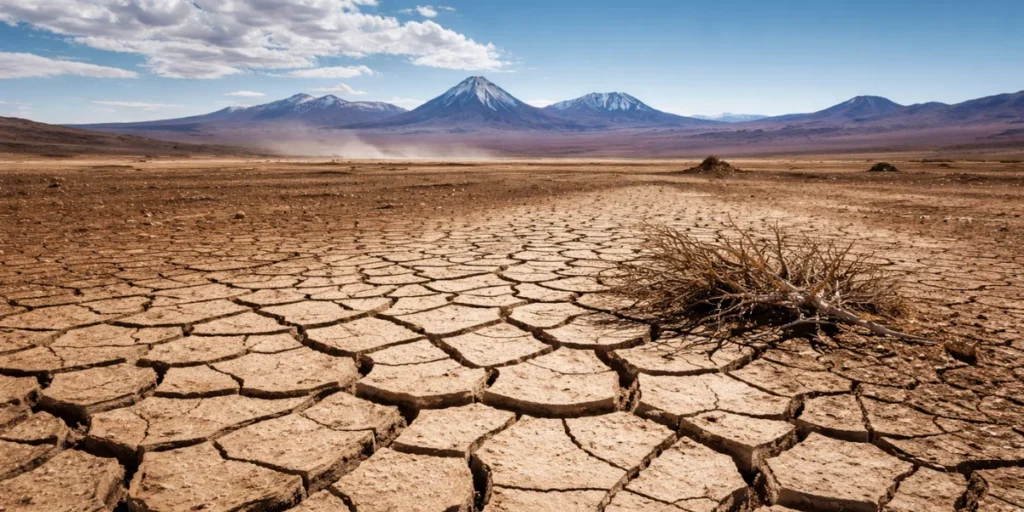
In these areas, the soil is so dry that it lacks even the microorganisms common in other deserts. The surface appears hard, cracked, or covered with crusts of salt and minerals, and any form of life is virtually invisible. These are landscapes that seem barren, but in reality, they exist in a state of extreme equilibrium, where the absence of water is the absolute norm.
This fact is not just interesting; it's key to understanding why the Atacama is so special. It's not a "temporary" or cyclical desert. There are areas that have gone thousands of years without rain, something that doesn't happen anywhere else inhabited on the planet.
Why Atacama is compared to Mars
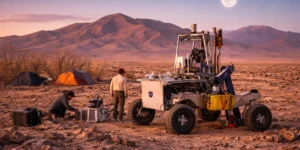
The comparison between the Atacama Desert and Mars is not a poetic metaphor, but a scientific analogy. Both share very similar conditions: salt-rich soils, very little organic matter, high radiation, and extreme aridity. In some areas of the Atacama, microbial life is so scarce that it approaches the limits of what is considered habitable on Earth.
Visually, the similarity is also evident. Reddish and ochre landscapes, an almost total absence of vegetation, wide horizons, and a constant feeling of isolation. Walking through certain parts of the desert produces that strange impression of being out of place, as if the landscape didn't quite belong to our planet.
But what's most important is what you can't see. Atacama allows scientists to study how minerals, sediments, and possible traces of life are preserved in a dry environment for millions of years. That's exactly what scientists are trying to understand when they analyze Mars: what remains when the water disappears and how to interpret those signs.
How extreme drought affects the landscape and life
The extreme aridity of the Atacama has sculpted a harsh, pristine, and strikingly detailed landscape. Without regular rainfall, water cannot soften the terrain or create fertile soil. Wind and temperature fluctuations are the great sculptors, creating sharp shapes, polished surfaces, and structures that appear almost artificial. Everything looks more defined, more striking, because nothing "erases" it.
As for life, adaptation is extreme. Plants, animals, and microorganisms exist only where there is even the slightest possibility of water, whether in oases, specific ravines, or areas influenced by coastal fog. Outside of these places, life is almost nonexistent. This doesn't mean that the Atacama is dead, but rather that life here operates at its limit, with very precise survival strategies.
That combination of stark landscape and minimal life is what makes the Atacama so impactful. It's not a friendly or verdant desert; it's an honest desert. It shows what the Earth looks like when water disappears, and that's why it's so valuable to both science and any traveler who wants to understand the limits of nature.